GranPa & Zoé : Mission Light, our latest production

GranPa & Zoé : Mission Light, our latest production

GranPa et Zoé: Mission Light, our latest project

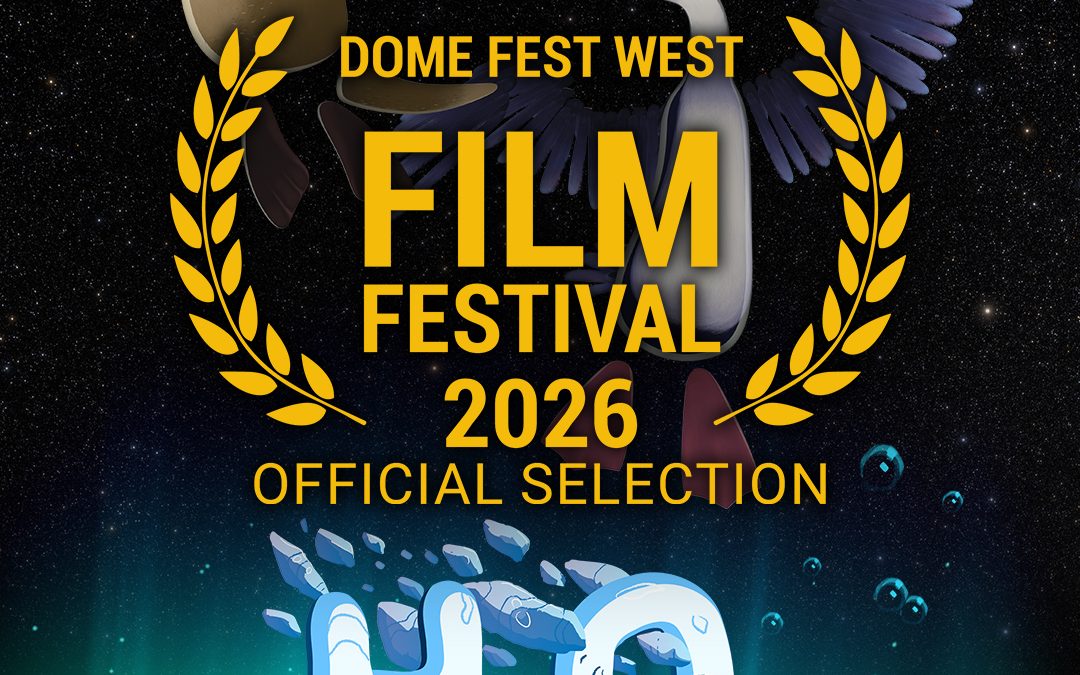
Three years after the release of Lucia, here’s our latest project: Granpa & Zoé Mission Light!

Electromagnetism and space travel

Seq140_Shot081

It’s the story of an old koala bear and a young dingo who are brought together to save the light. Yes, when you put it like that, the concept may sound far-fetched. But it hides a film in which we’ve put everything we love: scientific content, tongue-in-cheek humour, endearing characters, spaceships and nods to our favourite films.

How did we manage to make a film that looks so much like us? The answer is simple: we didn’t commission it, we created it entirely ourselves. We are both directors and co-producers. It’s a first for us. And let’s be frank: we’re proud of the result. So we’re off to a great start, building a catalogue that we hope will grow over the years.

Let’s introduce ourselves

A film is first and foremost a cast of characters that we like to follow on their adventures. We’d like to introduce…

GranPa

Gdpa

A retired scientist, GranPa spends his old age fishing, stuffing his face with eucalyptus sticks and talking for hours about the mysteries of the universe. Yes, he’s passionate about astrophysics – what better way to talk about light? – but he’s also very impulsive, and a bit of a scatterbrain. Two traits that don’t mix well, as you might guess. His passionate impulses often get him into uncomfortable situations. But it’s always with a dry sense of humour that he gets out of them. GrandPa may repeat that he wants to take it easy on his ranch, but he’s still very enthusiastic when adventure knocks on his door. Proof that he’s not that keen on retirement.

Zoé

Zoe

Without Zoé, GranPa’s retirement would probably be very boring. She regularly comes to visit him at his ranch. They share a passion for science. Zoé is a curious girl. She has a thirst for understanding and finds the answers she needs in GranPa. But her youthful energy should not be mistaken for naivety or recklessness. Quite the opposite. In perilous situations, Zoé is more measured than GranPa, and she reproduces brilliantly what she learns from him. When GranPa’s absent-mindedness puts the duo in danger, Zoé’s reflexes make up for it.

Bogbog

Bogbog

Meet Bogbob. A teenage alien who has found no better occupation than to harm our planet. An old enemy of GranPa’s, we can imagine past confrontations, desires for revenge never satisfied, a long list of thwarted plans. These two will never love each other. Perhaps it’s a generational mismatch, because at his age Bogbog is in the throes of an adolescent crisis. He spends his time geekering and talking back to his parents (too lax in our opinion). All this makes Bogbog a totally ungrateful character, with no empathy for living species. He carries out his attacks from his bedroom, on his keyboard. But there’s nothing Machiavellian about Bogbog – he’s not intelligent enough to be, he just wants to get on with the game. Opposing his plans is like switching off your console in the middle of a game. You’re sure to piss him off even more.

PS: don’t take this as a serious dig at gamers, because at 3D emotions, we’re gamers too. And not just a little! With Bogbog, we’ve made a bit of a caricature of ourselves.

Light, action!

Seq140_Shot081

Light is essential in astronomy, but it is rarely the subject of educational films.

We could not observe the stars without it, nor understand them without the information it contains. It gives us the composition, distance and movements of the stars. It is therefore the raw material of astronomers.

This is something that the public is perhaps unaware of, or does not fully appreciate. Nor do they imagine that the study of light could be the source of major discoveries.

But that’s not the whole story. The interesting thing about light is that it combines many things. Understanding its nature allows us to understand, among other things, colours, why the sun heats and illuminates us, and what infrared and ultraviolet light are.

Light is a surprising subject, because it allows us to make the connection between things we thought were foreign to each other. For example, it’s always surprising to learn that microwaves and light are the same thing, or that our eyes only perceive part of light, in the form of colours, and that a large part remains invisible to us.

It’s this astonishment that we wanted to convey.

Our approach to popularisation

Seq070_Shot130

Popularising science in a documentary is one thing – you can talk straight about it. In a story, it’s quite another. The scientific act must have a raison d’être.

All the twists and turns must naturally revolve around the subject. Starting with the trigger for the adventure. Light is both the goal of the characters, who are trying to save it, and the means to achieve it, because they need to understand it in order to move forward.

We conceived Granpa & Zoé as a two-stage learning experience. The beginning calmly introduces the important scientific concepts. Then the adventure gives them the opportunity to put them into practice.
The space voyage and the final tests serve as a reminder of what has been said, but in the form of phenomena to be understood and puzzles to be solved.

The biggest challenge, however, was to keep it fun and educational at the same time. How, for example, do you tackle the concepts of the geometry of light in a way that is still enjoyable for the audience? The solution lay in the writing and directing: science, yes, but motivated by pleasant narrative challenges, and with that, endearing characters, visual gags, good words and, above all, rhythm!

Data sheet

Duration: 28 min

Format : Fisheye

Versions :

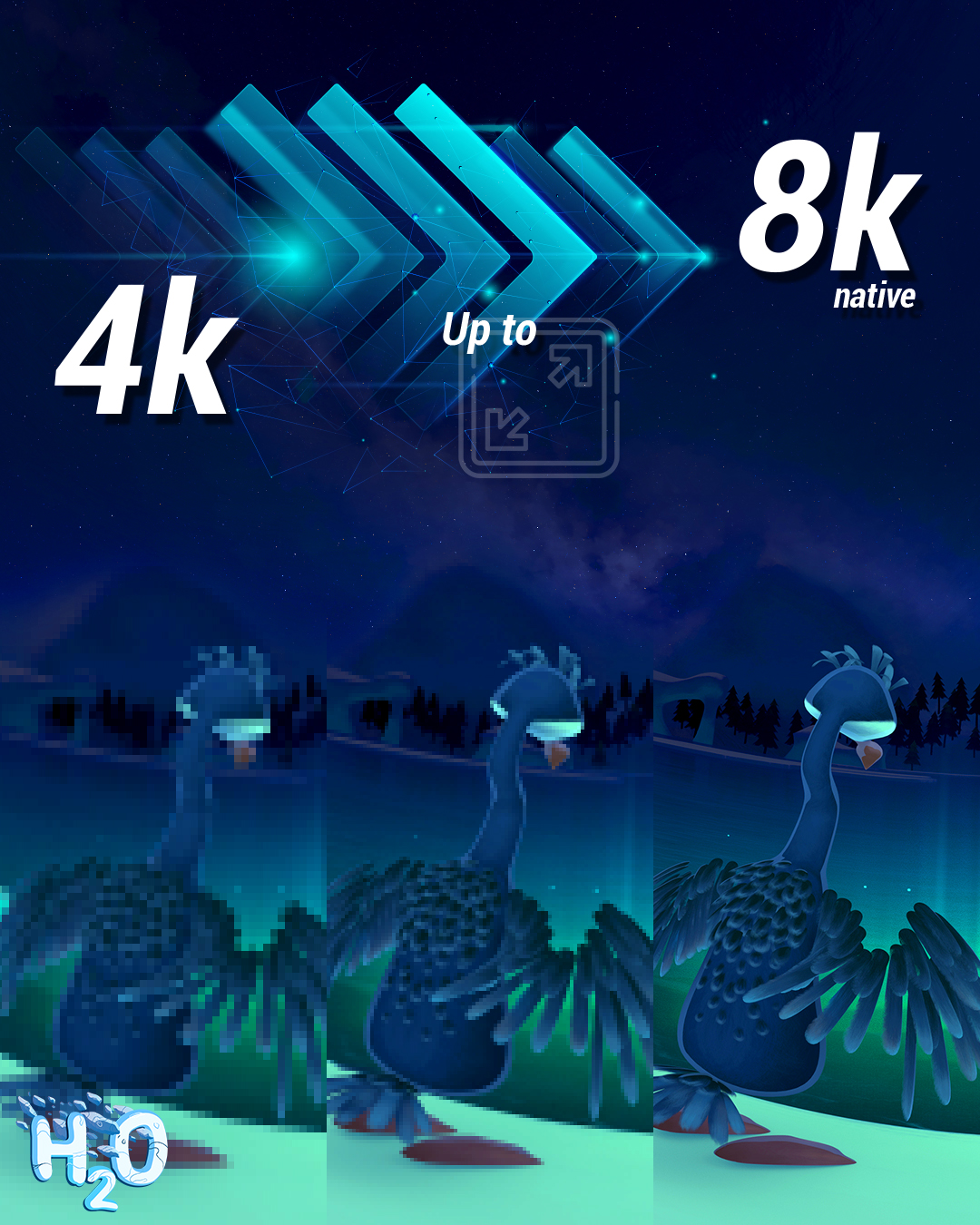
  • 4k
  • 6k
  • 8k
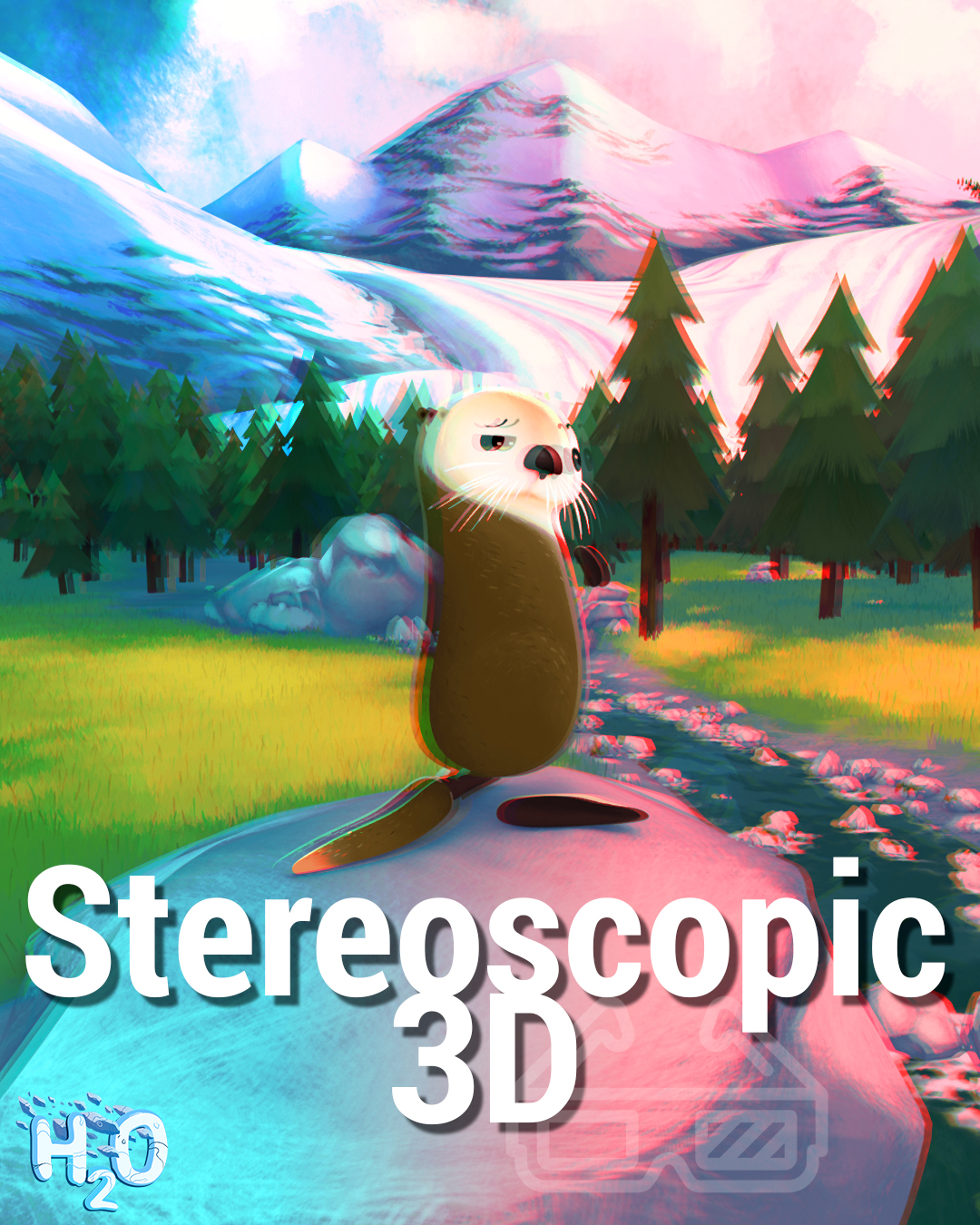
  • 4k relief
  • 6k relief
  • 8k relief

TargetAudience: 7-12 ans

Language: en version anglaise et française

Exclusive Distributor : RSA Cosmos

Full Dome Demo Reel: the opportunity to look back a little on our immersive films

Full Dome Demo Reel: the opportunity to look back a little on our immersive films

Full Dome Demo Reel: a chance to take a look back at our immersive films

First, a short 360-degree trailer of our full dome productions, just for your viewing pleasure.

We love making films for planetariums, we’re proud of it and we wanted to share that pride in a trailer. It has to be said that our films draw on all our skills. In a sense, all 3D emotion can be summed up in these productions: our love of 3D animation, our curiosity about scientific subjects, and our inclination for original broadcasting techniques.

Virtual reality before its time

First of all, we were the first in France to produce immersive full dome 3D films. This means 3D everywhere you look, in a 360-degree format. In 2010, when our film Planets was released, this was something that was difficult to achieve and had never been done before.

Since then, publishers have had time to propose solutions to studios, but at the time virtual reality didn’t yet exist, and we had to create our own tools to meet this demand.

Impertinent as we are, we didn’t wait for the advent of virtual reality to make our own. And we enjoyed experimenting with the 360-degree format in our productions. We’ve tried out a lot of things when it comes to directing, and we’ve learned a lot more too.

Placing the action, constructing the narrative in an open format, managing shots, camera position and movement – we’ve been testing all these things since our first planetarium film, The race to Earth.

As our work has progressed, we have perfected our methods. One of them is to preview our immersive films using an Oculus headset, which is the best way for us to test our directorial choices.

Without realising it, we were already experimenting with virtual reality. After all, what is virtual reality if not a mini planetarium? You could even say that the VR headset is to the planetarium what television is to the cinema: an individual version of an experience that has long been tried and tested in public.

But our expertise doesn’t stop at immersive and virtual reality.

Immersive films, but also films to popularise science

As we said in the introduction, our productions bear witness to our scientific side, since each in its own way unfolds educational content (more or less specialised depending on the film).

While our productions have taken us to a variety of subjects (marketing, retail, medical, industry, real estate), it is above all astrophysical and environmental issues that have most appealed to our scientific spirit.

Because to bring these subjects to life, you first have to be completely committed to them and immerse yourself in cutting-edge issues (enough to forge a real general knowledge). Then you have to be able to process data supplied by professionals.

Very early on, our productions led us to manipulate scientific data to make films or applications for the general public.

For planetariums, we represented various cosmic bodies under the watchful eye of cosmologists and planetarists (stars, planets, nebulae, galaxies). We have also worked with institutions to produce films and applications on a wide range of issues, requiring us to work closely with specialists.

All of these projects involved introducing information directly from simulations or surveys. In each case, not only was scientific rigour required, but the documents we were working with were data specific to their field that we had to understand and process. Data that we had to be able to read, integrate and transform without touching the information it contained.

So it’s a skill that goes beyond the job of computer graphics designer, animator and director. It’s a sort of 3D emotion supplement, a geeky side and a natural curiosity shared by the whole team.

Polaris, a refreshing production!

Polaris, a refreshing production!

Polaris, a refreshing production!

3D Emotion is proud to present Polaris, a 3D planetarium show. Polaris is a 28-minute animated educational film produced by the Saint-Etienne planetarium and illustrated by 3D Emotion. Aimed at a young audience from 6 to 13 years old, the film deals with the scientific approach based on astronomy: putting forward hypotheses, observing, experimenting and making deductions.

‘James, a travelling penguin from the South Pole, and Vladimir, a funny bear from the North Pole, meet on the Arctic ice floe. As apprentice astronomers, they wonder why night is so long at the Earth’s two poles.

Their scientific adventure takes them from building an observatory to constructing a makeshift spaceship. On a journey around the Earth and then to Mars and Saturn, they will answer their questions and discover that the planets have things in common, but also differences!

Polaris Poster

Poster of the film

The preparatory production phase

In this adventure, 3D Emotion produced the images for the film, based on the script co-written by Jean-Marc Bouzigues (scriptwriter) and Eric Frappa (scientific and educational director of the Saint-Etienne planetarium) and directed by Eric Frappa. Our involvement began with the first sketches of the characters.

Model Sheet de Vladimir

Model Sheet of Vladimir

For the particular landscapes and lighting of the North Pole, we drew up a ‘Color Script’, which we used as a reference when we set up the lighting scenes.

Recherche d’ambiance

Atmosphere research

The staging

This production is highly immersive. It is ‘fulldome’, meaning it is designed to be broadcast on a 360° vault. The immersion is enhanced by a 3D projection, using passive stereoscopy (Infitec technology to be more precise).

As with any immersive production, special attention has been paid to the staging. The authors took this into account when writing the script, which helped us to stage sequences that took full advantage of the immersive effect.

Pour la descente en luge-frigo dans les méandres des crevasses glaciaires, sensations garanties.
You’re guaranteed a thrilling sledge ride down the meandering crevasses of the glaciers.

We also experimented with integrating the Oculus Rift into our production pipeline. The Oculus Rift is a virtual reality headset that allows users to immerse themselves completely in a 3D world.
We used it to test staging, 360° framing and 3D adjustment.

Vision pour chaque œil, dans l'Oculus Rift

Atmosphere research

The results are very convincing, very close to the perception in the projection room.

The animation

We used the XSens system (a motion capture system based on inertial sensors) to animate the characters’ bodies. Bastien, from the 3D Emotion team, took it in turns to play James the penguin and Vladimir the polar bear.

We then carried out a meticulous retargeting process. As the animations are captured according to the actor’s morphological proportions, retargeting consists of adapting them to the proportions of the characters for whom they are intended. In our case, a short-legged penguin and a pot-bellied bear. To help Bastien in his performance, we ‘perfected’ the outfit a little…

Le hamac ? Pour jouer les scènes en apesenteur, bien sûr !

The hammock? For weightless scenes, of course!

We used traditional keyframe animation to animate facial expressions and lip-synch.

Rigging facial pour les expressions du visage et la synchronisation labiale
Facial rigging for facial expressions and lip synchronisation

The soundtrack

The musical creation, voice recording and sound design were carried out by the Lyon studio AudioPigment, Damien Laquet and Léo Morfun lent their voices to James and Vladimir respectively. The entire sound production was spatialised and broadcast in 5.1 to enhance the immersive effect.

Studio audio pigment

Generating final images

The calculation of the final images, or ‘rendering’ in our jargon, is always subject to a balancing phase.
We have to find the right balance between calculation time, the hardware resources of our computer park and the quality of the image to restore all the details and the lighting atmosphere before the deadline, so that the film can be broadcast one day. In the case of Polaris, for the school holidays in February 2015.

For this animated show, this rendering phase is not insignificant, because we generate images in ‘Ultra High Definition’, to ‘Fulldome’ standards, i.e. images in 4,000 pixels x 4,000 pixels.
To suit the international market, this 28-minute film is broadcast at a rate of 30 frames per second.
Finally, because the film is in 3D, it requires 2 streams, one for each eye.

In a few figures, this production represents :

  • 50,400 images for the traditional version, 100,800 images for the 3D version.
  • An average of 12 minutes of calculation per image, or 1,330 days for a single calculation cluster, 3 months for our rendering farm.
  • Nearly 5 TB of data generated > to store, manage and secure.
  • More than 6,000 coffee capsules over 10 months of production.

3D Emotion know-how

Polaris is our 5th fulldome show project.

Drawing on our experience in staging immersive films, we adapt and develop tools to best meet the needs of this type of production.

For this production, we refined and optimised the lens of our virtual camera. It enables us to obtain an immersive projection, with relief perceived over the entire vault.

Image dite « fish-eye »
So-called « fish-eye » image, standard for films shown on a dome

This process is still unique for fulldome productions in France, and to our knowledge in Europe. Other productions are limited to a relief effect in the direction of the action, which reduces the feeling of immersion offered by the vault.

Polaris is still a little young to draw significant figures from it, but it was very well received by the planetarium public upon its release.
Already acquired by the planetariums of Dijon, Ager (Spain) and Ventspils (Latvia), it has just won the Audience Award at the international fulldome festival in Brno in the Czech Republic.
3D Emotion invites you to discover the trailer on our website: Polaris Trailer


Crédits : production : planétarium saint-etienne direction : Éric Frappa (Planétarium de Saint-Étienne) scénario : Jean-Marc Bouzigues Éric Frappa (Planétarium de Saint-Étienne) direction artistique 3D & design graphique : Damien Maugin (3D Émotion) modélisation, textures & lumières : Damien Maugin, Bastien Balandras, Jérémy Mathecowitsch, Vincent Arrouy (3D Émotion) skinning & morphing : Stéphane Bertrand (3D Émotion) animation & motion capture : Bastien Balandras, Damien Maugin (3D Émotion) recherche & développement : Stéphane Bertrand, Nicoulaïe Vernouillet-Mula (3D Émotion) enregistrement, son et mixage : Romain Noiret (Audio Pigment) musique originale : Audio Pigment voix : James Hibernatus : Damien Laquet & Vladimir Chekov : Léo Morfun capture Sky Explorer v3 : Laurent Asselin (Planétarium de Saint-Étienne) crédit images : NASA/The Hubble Heritage Team (STScI/AURA) ESA/G. Neukum (Freie Universität, Berlin)/Bill Dunford
Résumé de la politique de confidentialité

Ce site utilise des cookies afin que nous puissions vous fournir la meilleure expérience utilisateur possible. Les informations sur les cookies sont stockées dans votre navigateur et remplissent des fonctions telles que vous reconnaître lorsque vous revenez sur notre site Web et aider notre équipe à comprendre les sections du site que vous trouvez les plus intéressantes et utiles.